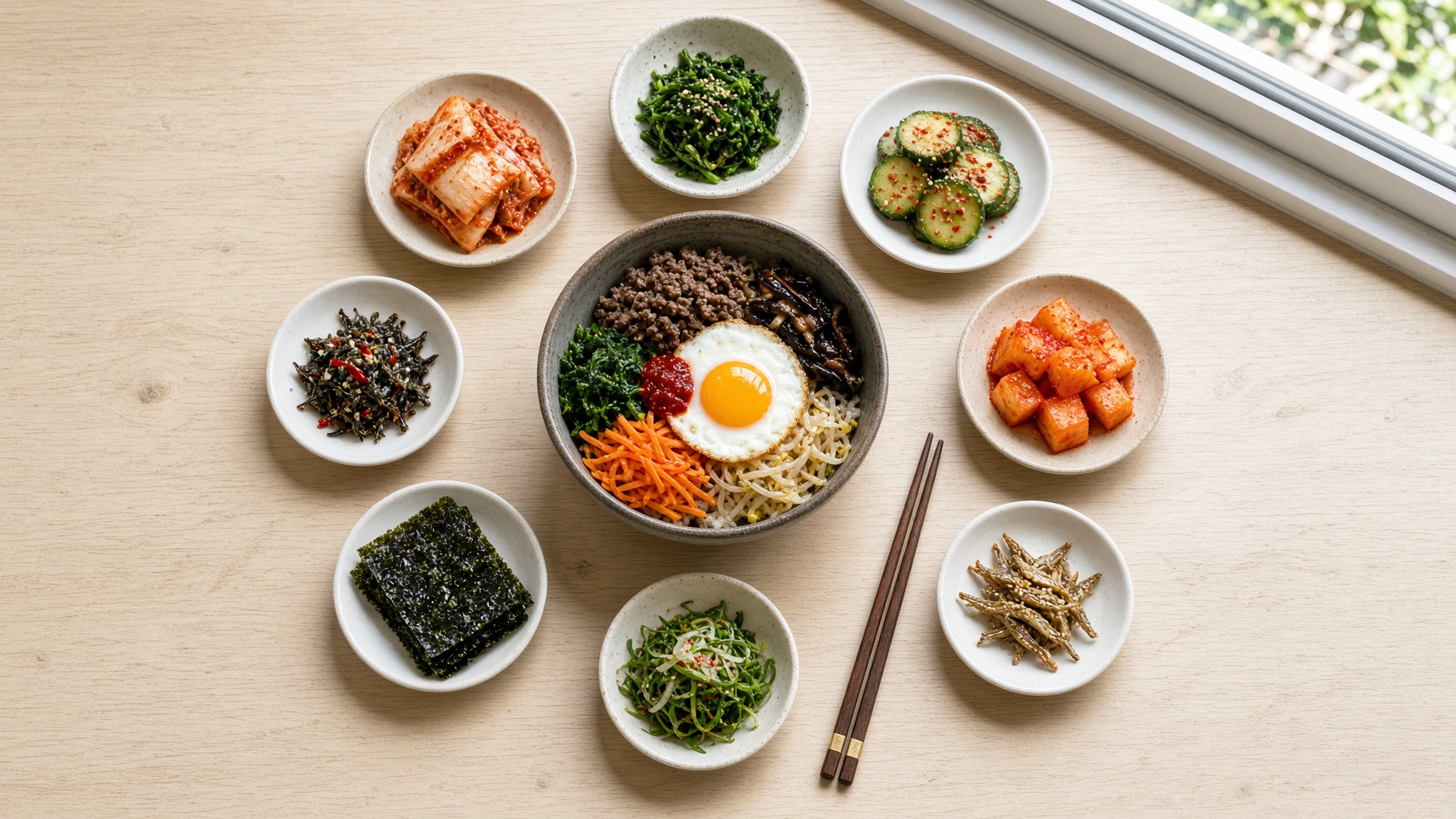
The first time I went out for a meal in Korea, there were eight little plates spread across my table — and I didn't touch a single one.
I wasn't sure I could pay for them.
I counted, really
Kimchi, bean sprouts, spinach, shredded radish, rolled omelet, stir-fried anchovies, fish cake, and something black I couldn't identify.
I had ordered one bibimbap. Eight plates came out. I checked the menu again. Bibimbap, 9,000 won. That was all it said.
So how much were these eight?
I had no idea what the bill would come to, so I kept my hands off. Ate my bibimbap and left.
On my way out, one of the staff looked at the plates and asked me something. I think she was asking whether the food wasn't to my taste — but back then I couldn't understand, so I just smiled and walked out.
I worried about the water too
Same story with the water. It wasn't on the menu, so I assumed you had to order it separately.
This part needs some explaining: in Germany, water isn't free. Order water at a restaurant and you get a bottle, and it's billed separately. Ask for tap water and plenty of places won't give you any.
So worrying about the water bill wasn't strange of me — I was just thinking in German terms.
But the moment I sat down, the staff set a jug and a cup on my table and walked off. I had ordered nothing.
I didn't drink it for the longest time, afraid this would end up on the bill too. Eating bibimbap with a cup of water sitting right in front of me.
I found out later. The water is simply given. Sit down and it comes, and no price is ever put on it.
Some places put a water dispenser off to one side instead, and everyone serves themselves. In that case the cups are stacked next to the dispenser — go pour your own and bring it back. Either way, you don't pay.
It took me about two months
I was eating with a Korean friend when he finished off one of the 반찬 (banchan) — the side dishes — called the staff over, and asked for more.
"Doesn't that cost extra?" I asked.
He laughed and said, "It's free. Giving you more is how it works."
When I told him I'd barely eaten any 반찬 for two months, he was genuinely sad for me. "But they give you those so you'll eat them..."
| What I thought | Reality |
|---|---|
| Banchan are appetizers billed separately | Included in the price of the main. No extra charge |
| Water is something you order and pay for | Free. Brought to your table, or self-serve from a dispenser |
| Once it's gone, it's gone | Ask for more and you get more |
| How much should I tip? | There's no tipping culture at all |
How to ask for more banchan
Say this and they refill it right away. No need to feel the least bit awkward about it.
That said, it's not universal. The lettuce wraps at barbecue places, or spots with a self-serve bar, sometimes charge starting from the refill. Those places usually have a sign up, so one look will tell you.
Once I knew this, eating out changed completely for me. I used to eat just the main and leave; now I start with the 반찬.
I wondered why it's free
I looked into it, and apparently that's just how a Korean table is built.
It's not one main dish arriving on its own — it's rice and soup with several side dishes laid out, and you eat a little of everything together. So the 반찬 aren't a bonus; they're part of the table. Take them away and it isn't a proper meal anymore, which is why they don't get their own price.
Once I understood that, I actually started feeling bad about leaving any behind.
No tipping either
This one also had me agonizing at first. After paying, how much do I leave on top?
In Germany you usually leave 5–10%. You tell them to keep the change, or you round the number up when paying. It's so ingrained that in Korea I kept running the mental math anyway.
Korea has no tipping culture. Restaurants, cafes, taxis — none of them. The listed price is everything you pay, and tax is already in it. High-end hotels and some restaurants do add a service charge, but that's printed on the bill in advance — it's not something I decide.
I once tried to leave extra anyway, and the staff got flustered and tried to give it back. That's when I knew for certain.
You usually pay at the counter on the way out. Not at the table.
Looking back now
The two months of not eating 반찬 is what I regret most. That was the most fun part of the Korean table.
So this is what losing out from not knowing looks like, I thought. One sentence from anyone would have been enough.
Did you have something like this on your first trip to Korea? Something you missed just because you didn't know? If so, tell me — then I'll know I wasn't the only fool.