The water showed up on its own. But nobody came to take my order.
I just sat there quietly
The moment I sat down, a server set out water and wet wipes. Banchan was already on the table.
She brought a menu too — and since she could tell I was a foreigner, she opened it to the page with pictures. Up to this point, flawless.
"She'll be back soon," I figured, and picked my food. Then I kept sitting there after I'd picked.
I didn't know I was supposed to send a signal. So I sent none. Just kept my head down, staring at the menu.
The next table went 딩동
I watched the person at the next table press something on their table.
딩동 — ding-dong. A server came immediately.
I looked at my table. Same button, in the corner. It had been in front of me the whole time.
I pressed it. Someone was there in under five seconds. She even explained things slowly, in English. It wasn't that nobody came. It's that I never called.
They don't come — you call
At an American restaurant, the server keeps coming back. Refills your water, asks how the food is, clears plates. They swing by whether you ask or not.
Korea doesn't work that way. They don't come until you call.
The setup happens automatically, but the order needs a signal from you. Those are two separate systems. I saw the automatic setup and assumed the order would be automatic too.
Once I understood it, I actually preferred it. Nobody interrupts you mid-meal. You eat in peace and call only when you need something.
| What I assumed | Reality |
|---|---|
| Wait and they'll come | They come when called |
| Calling feels like rushing them | That's the normal way. Nobody minds |
| They're ignoring my table | No signal, no visit. Send one and they're right there |
There are three ways to call
It varies by restaurant. When you sit down, scan the table first.
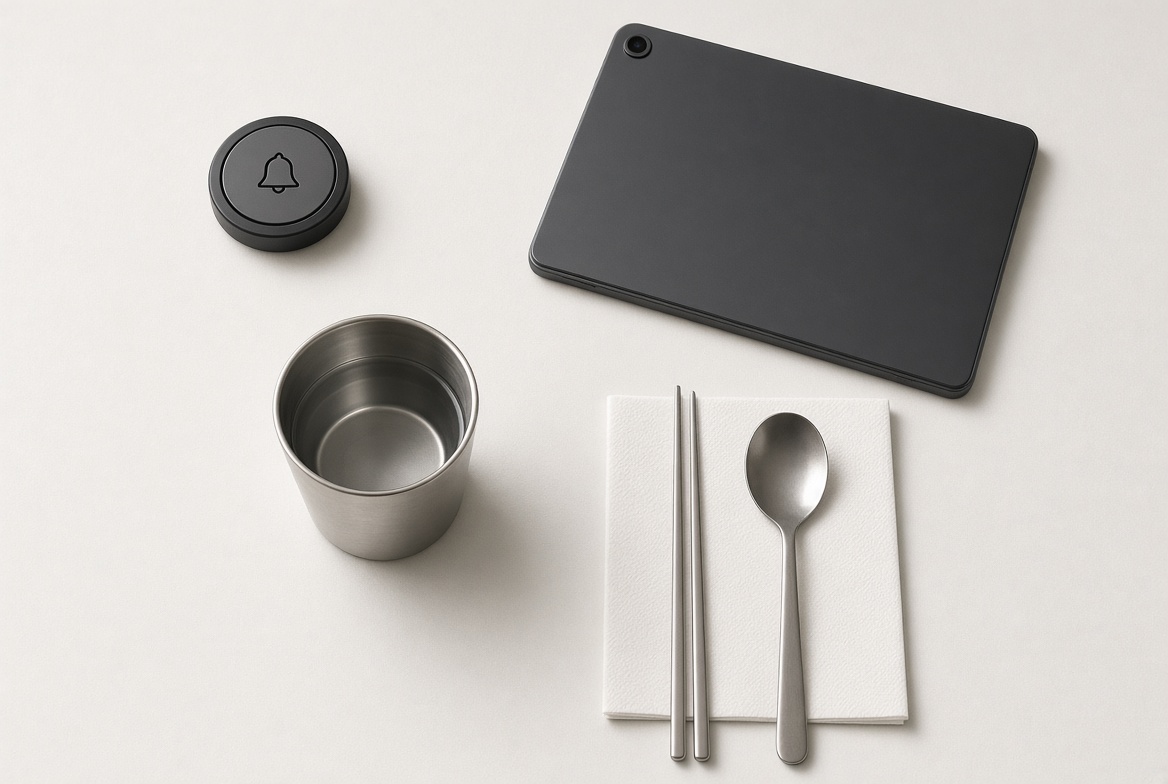
One: the tablet. The most common these days. A screen mounted on or standing at the table. Look at the photos, pick, hit the order button, done. You never have to call anyone.
Honestly, this one's the easiest. No Korean needed, since there are photos. A good number have an English button too. If not, tap what looks good in the pictures.
Two: the call bell. A small button at the corner of the table. Press it, it goes 딩동, and a server comes. That's the one I failed to spot.
Three: just calling out. Places with no tablet and no bell — common at baekban joints (home-style set-meal diners) and old-school restaurants. Here you call out loud.
Calling out loud scared me the most
I assumed this was rude at first. In the States, yelling for a server across the room is a bit much.
But here, this is the way you call someone. No shouting required — just loud enough to be heard. Nobody turns to look at you.
"여기요" works exactly the same. Use either one.
What to say once they come
They come when you call, so it helps to have the next line ready.
If you don't know the name of the dish, point at it and say this.
I survived on those two lines alone for quite a while. Zero problems.
Now
When I sit down, I check the table first. Tablet? Bell?
If there's one, use it. If not, "저기요." That's the whole system.
Looking back, the staff that day were incredibly kind to me. The water, the banchan, the picture menu.
All I had to do was say one word. I just didn't know the word.