I tried to save a few hundred won on a plastic bag at a convenience store, and walked out carrying everything in my arms.
I said 괜찮아요 to avoid buying a bag
Bags aren't free in Korea. You buy one at checkout if you want one.
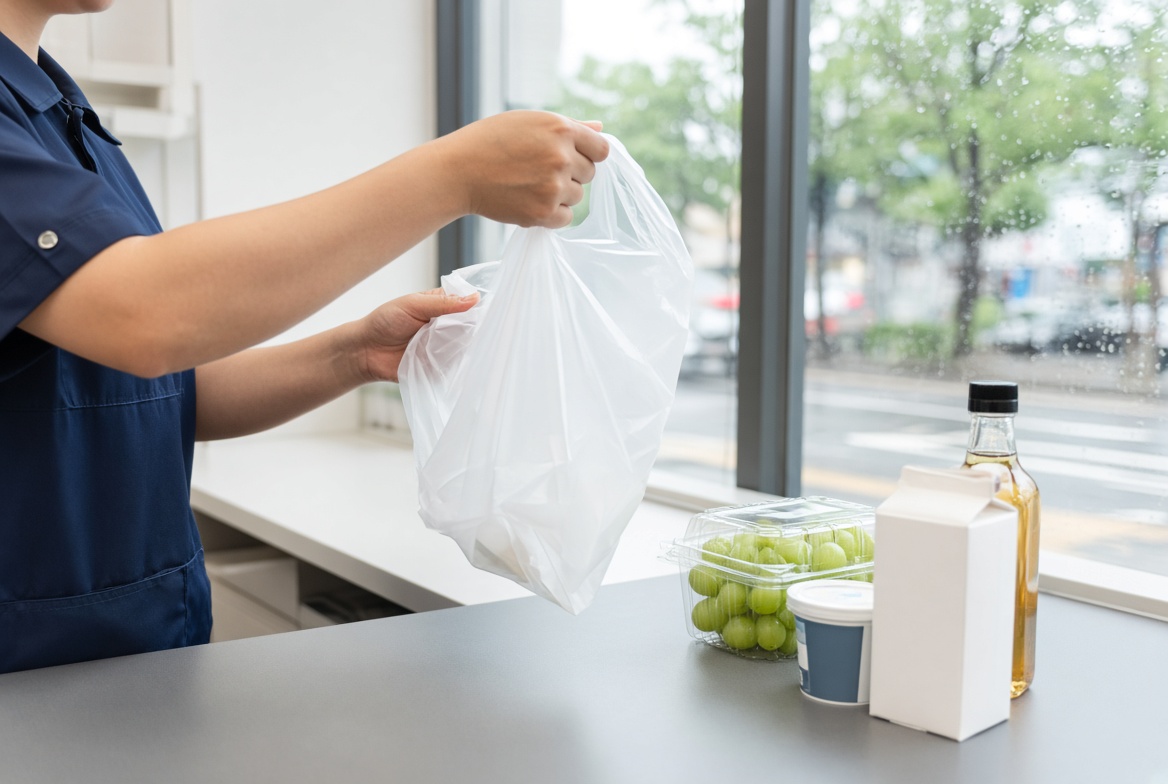
I grabbed a few things and put them on the counter. As the total came up, the clerk glanced out the window.
I caught 봉투. Bag. She's asking if I want to buy one, I thought.
So I said 괜찮아요. Meaning: no thanks, I'll skip it.
She nodded and pushed my things across the counter. So far, exactly what I wanted.
The problem started outside. It was raining, and I had to walk holding everything against my chest. That's when it hit me why she had looked out the window before asking.
A few days later I heard the same word mean the opposite
A café, no free tables. There was one empty chair at the next table, so I asked.
"여기 앉아도 돼요?" — can I sit here?
She said 괜찮아요.
I took it as a no, said "아 네," and backed off.
Except she was already pulling the chair out for me.
Same three syllables. At the convenience store it was a refusal. Here it was a yes.
The shape of the question splits it
I told a friend both stories and he sorted it out in one line, laughing at me the whole time.
If they're offering to do something for you, it's a no. If they're asking whether they may do something, it's a yes.
| What they asked | What 괜찮아요 means |
|---|---|
| "봉투에 담아드릴까요?" ("shall I bag it?") | No — you don't need to |
| "커피 한잔 하실래요?" ("want a coffee?") | No — I'll pass |
| "여기 앉아도 돼요?" ("may I sit here?") | Yes — go ahead |
| "이거 먹어도 돼요?" ("may I eat this?") | Yes — help yourself |
But there's an easier way
I was busy memorizing that table when he gave me a much better version of it.
괜찮아요 isn't answering the question at all. It's erasing the worry the other person is carrying.
Here's what that means. When someone asks you something like this, they're worried about something. Erase the worry and the meaning falls out on its own.
| Their worry | Erase it and you get |
|---|---|
| He'll get soaked | You don't need to bag it (refusal) |
| Am I in his way | Go ahead and sit (permission) |
| Is he badly hurt | I'm not hurt (condition) |
| Did I mess up | Don't worry about it (forgiveness) |
So 괜찮아요 is neither yes nor no. It's closer to you don't have to worry about that. Depending on what the worry is, some days it lands as a refusal and other days as a yes.
That last row I only worked out later: when someone says "죄송합니다," you answer 괜찮아요. Same thing — you're erasing the part where they feel bad.
Japanese and English do this too, actually
This isn't some Korean weirdness. Say "I'm good" to "More coffee?" and that's a refusal — a word meaning good, used to say no. 괜찮아요 is doing exactly that.
Japanese 大丈夫です goes even further. It does the refusal, and it also works as a yes when someone asks whether they may do something — the same double duty 괜찮아요 pulls. Japanese speakers get tangled up in it with each other for exactly that reason.
So the split isn't a Korean quirk at all. If anything, English is the odd one out here: "I'm good" only does the refusal half. It makes no sense as an answer to "may I sit here?", where 괜찮아요 and 大丈夫です both work fine.
So I put one word in front
A bare 괜찮아요 isn't a finished sentence. The listener has to look around it and guess.
So take the guessing away.
| What I used to say | What actually gets across |
|---|---|
| "괜찮아요" (trying to decline) | "아니요, 괜찮아요" |
| "괜찮아요" (wanting it, being polite) | "네, 주세요" |
| "괜찮아요" (giving permission) | "네, 앉으세요" |
Adding a reason to a refusal softens it further. "아니요, 괜찮아요. 가방 있어서요." — no thanks, I've got a bag. Now it isn't a rejection, it's a circumstance, and it's easier on both of you.
One meaning that sits outside all this
Everything up to here was about erasing worry. But 괜찮다 has one more meaning that has nothing to do with that.
괜찮은 가격, 괜찮은 식당 — all of these. It means not bad, pretty good. Not amazing, just solidly that.
So there are only two things to know about 괜찮다.
| When | Meaning |
|---|---|
| Answering something someone asked | You don't have to worry about that |
| Describing a person or a thing | Not bad, pretty good |
This one caught me out too. A friend said her blind date was a 괜찮은 사람 and I thought "ah, so nothing went wrong." It actually meant she liked him.
What I do now
If I want it, I skip the polite refusal and say 네, 주세요. If I truly don't need it, 아니요, 괜찮아요. I stopped tossing out a lone 괜찮아요.
And ever since that day, when someone asks about a bag at a convenience store, I answer straight away. Especially when it's raining.
How about you? You're not still assuming 괜찮아요 covers everything on its own, are you?