I'd been going to the same shop for about three months when, one day, the bill stopped adding up.
Something I didn't order arrived
It's a noodle shop near my office. I went often for lunch, always ordering the same thing.
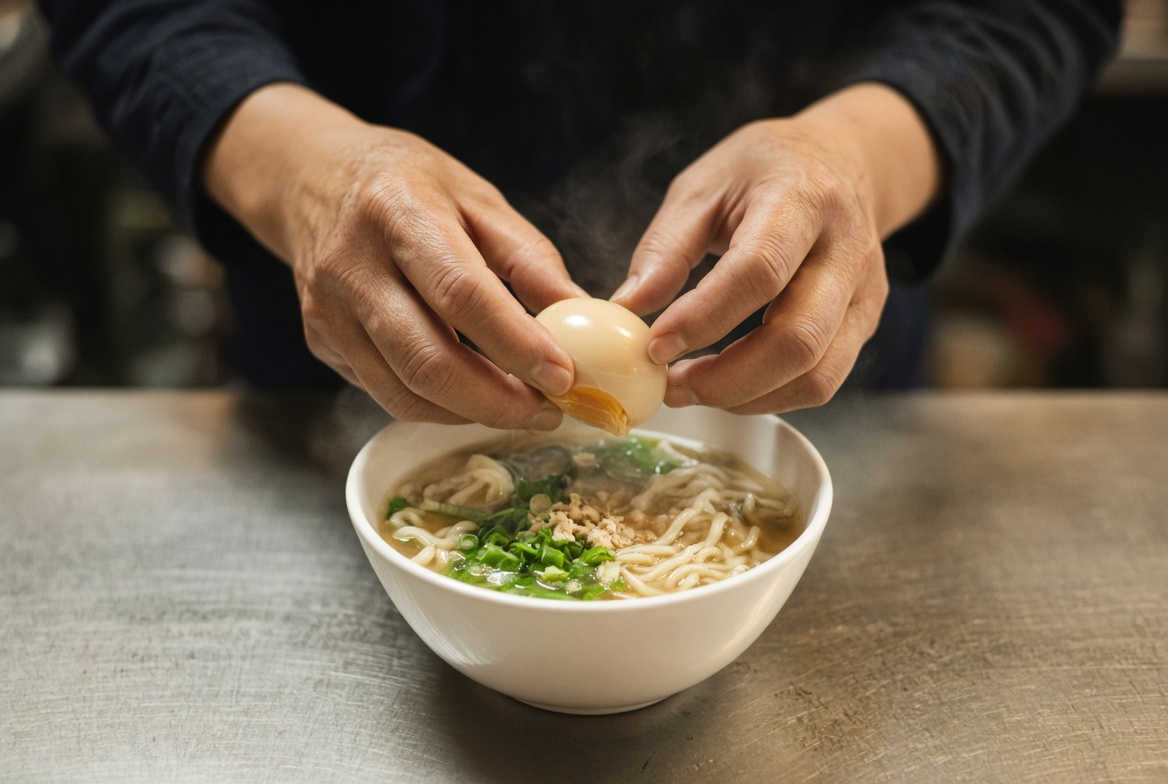
One day my noodles came with an egg on top. I hadn't ordered one.
I assumed it was a mistake and said so — this isn't what I ordered.
The woman at the counter waved her hand. "그냥 드세요." Just eat it.
Then the price changed
A few days later, at the register, she took a thousand won less than the price.
I repeated the correct amount, and she waved her hand again. It's fine, she said.
This kept nagging at me. In Japan this rarely happens. A price is a price, and paying the same amount every time is what keeps things comfortable for both sides.
So the next time, I left the exact amount on the counter and got out quickly.
Looking back now, I think that was a little rude of me.
I didn't understand that this wasn't a transaction
I told a Korean coworker, and she laughed.
That's what's called 서비스 (seobiseu) — "service," she said. Giving a regular a little extra, or shaving a bit off the price. From the shop's side it's not a billing error. It's more like a greeting.
Which means when I left the exact money and walked out, I had effectively refused the greeting.
My coworker summed it up like this: "You don't pay it back in money. You receive it in words."
That was the answer. You settle it with a greeting, not with arithmetic.
The dropped politeness was a signal too
There was one more thing that had confused me.
At first she used polite speech with me, but at some point casual speech started slipping in. "오늘 늦었네?" — running late today? — that sort of thing.
In Japan, a shift like that can feel a bit rude. So I wondered what I'd done wrong.
But this was backwards too. It was a sign we'd gotten close. She'd started treating me as someone she knows, not as a customer.
Korean casual speech isn't so much talking down as it is saying the distance has closed. Once I understood that, I relaxed around her too.
So what am I supposed to do
Being on the receiving end all the time felt like a burden, so I asked — what should I do back?
According to my coworker, nothing, really. Continuing to show up is already the repayment.
But if you want to do something anyway, this is about the level.
Once, coming back from a business trip, I brought her some snacks, and she was delighted. That kind of thing is fine, apparently. Just not money.
Now
I still go to that noodle shop. These days she doesn't even ask what I'm having.
I sometimes think back to the day I left the exact amount and hurried out. I meant it as good manners, but from her side, it must have looked like I was drawing a line.
A bill that balances perfectly isn't always a good thing, it turns out.