
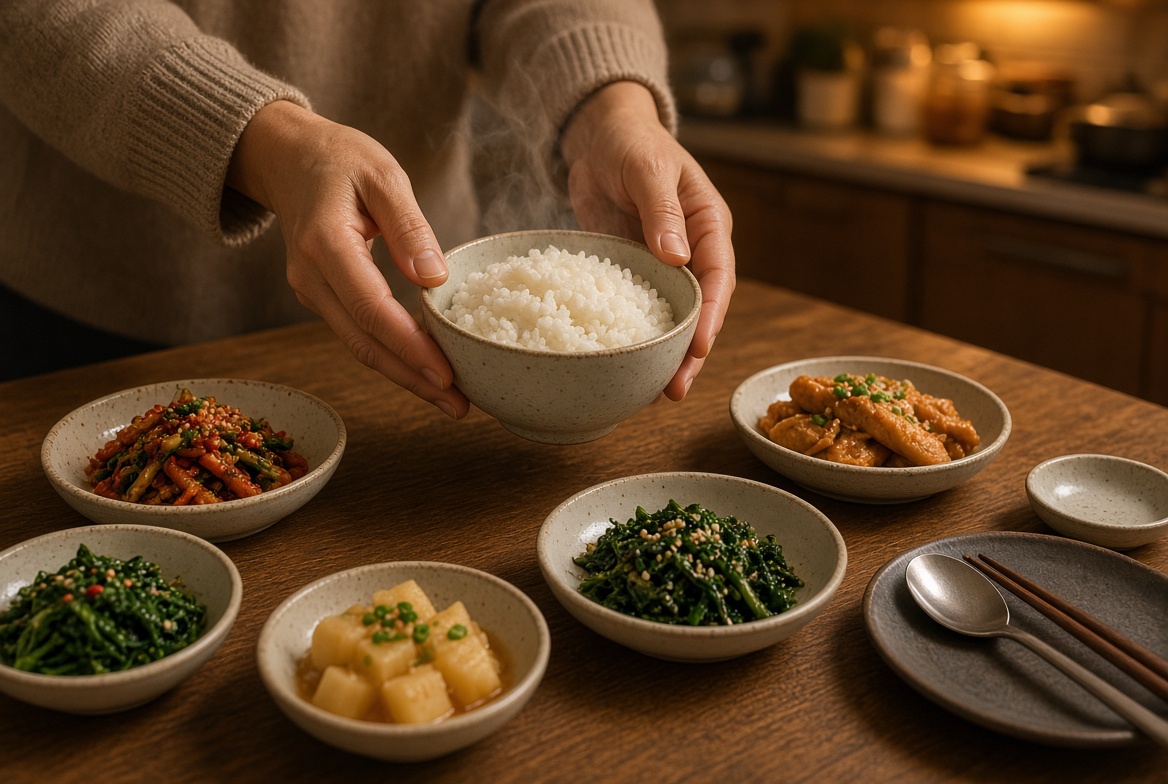
There was a day I ate dinner twice. Not because I was hungry — because I answered wrong.
I said 네 and food came out
The woman running my guesthouse asked me:
I had literally just eaten. So I thought it through in German: "Nicht gegessen?" → I did eat, so Ja. → 네 (ne).
And with that, she headed for the kitchen.
Ten minutes later, a full dinner appeared. My 네 had landed as "that's right — I haven't eaten."
네 points at something different
It took me a long while to work out. 네 and 아니요 (aniyo) point at different things entirely.
Here's a way to think about it that makes it easy. When someone asks you a question, they're holding out a sentence. "밥 안 먹었어요?" holds out the sentence you haven't eaten.
German and English ignore that sentence and describe my own action. I ate → ja. I didn't → nein. Whatever they held out doesn't matter.
Korean is the reverse. You say whether the sentence they held out is correct. Correct → 네. Wrong → 아니요.
So my 네 wasn't "I ate" — it was "that sentence is correct." And the sentence she'd held out was you haven't eaten. Hence the dinner.
| When "안 먹었어요?" comes at you | German | Korean |
|---|---|---|
| Really haven't eaten → the sentence is correct | Nein | 네, 안 먹었어요 |
| Ate → the sentence is wrong | Doch | 아니요, 먹었어요 |
"안 바빠요?" ("aren't you busy?") works exactly the same. Not busy → 네. Busy → 아니요. All you check is whether the sentence is correct.
German has a dedicated word for exactly this
You may have noticed it in the table: for this situation, German has a special word, doch.
A quick aside for those who don't speak German: doch is the word that flips a negative. Someone says "you didn't eat?" and a single "Doch" means "wrong — I did." English has no such word, which is why English speakers have to spell it out in two: "No, I did."
Which means I already knew this situation was confusing. Confusing enough that German went and built an entire word just for it.
The problem is that Korean didn't build a doch — it sorted the problem out in the opposite direction. Instead of adding one more word to do the flipping, it made 네/아니요 point at a different thing altogether.
Actually, Korean isn't the odd one out
I learned this later too: Japanese and Chinese work the same way as Korean.
Look at it globally and it's English and German that are in the minority. I'd been thinking Korean was strange, when I was the one who'd come from the strange side.
When in doubt, do this
Honestly, in the moment I still get confused. Especially when the conversation speeds up.
So these days I leave 네/아니요 out entirely.
This way you can't get it wrong. You ate → "먹었어요". You didn't → "안 먹었어요". It doesn't matter what was asked.
Koreans actually talk this way a lot themselves. The 네/아니요 isn't something you're required to attach.
Why this matters
One dinner is something you laugh off. But when this goes wrong around plans, it's a different story.
Answer "내일 시간 안 되세요?" ("are you not free tomorrow?") wrong and the whole appointment falls apart. I thought I'd said I was free; they heard that I wasn't.
Ordering food too. Answer 아니요 to "매운 거 안 좋아하세요?" ("you don't like spicy food?") and the spicy one is on its way.
Now
In the moment it still trips me up. But since I started answering with just the verb, getting it wrong has never landed me in trouble.
Fully mastering the rule and getting through without mistakes turned out to be two different problems. I solved the second one first.
And yes, I ate both dinners that day. You can't not eat what she'd laid out for you.